
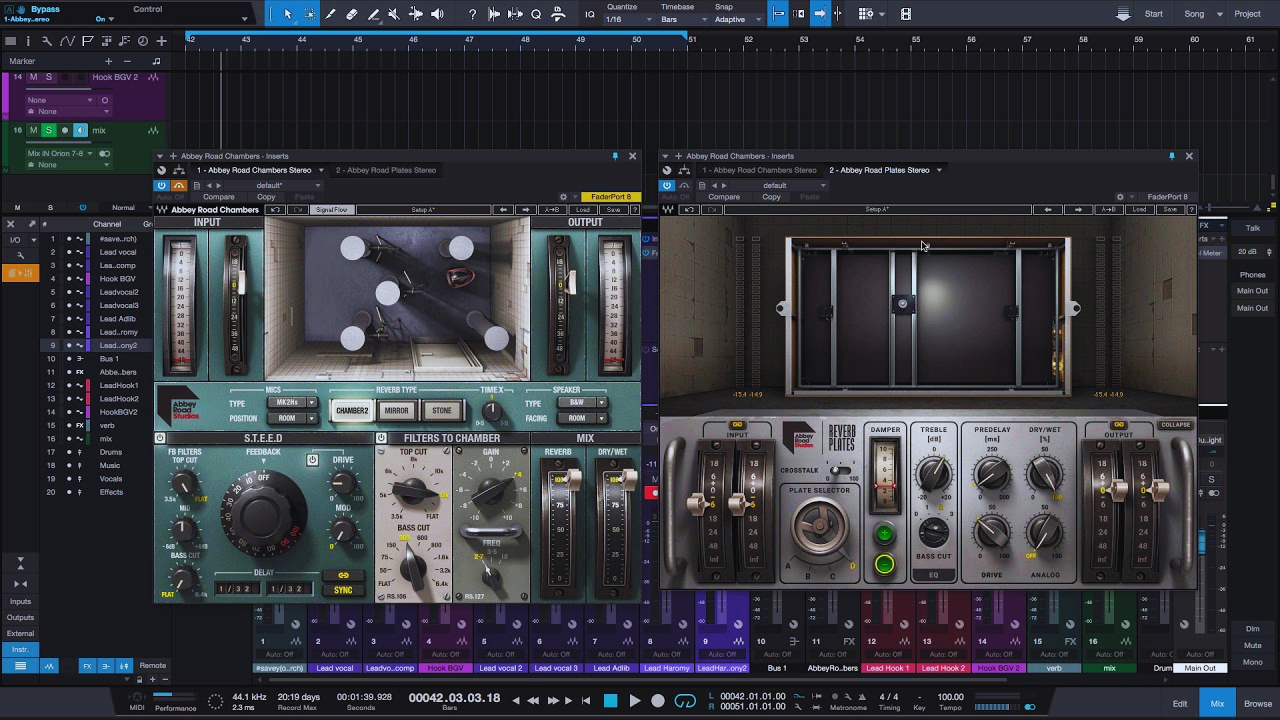
The Abbey Road Reverb Techniques That Shape Space, Energy, and Intimacy into Vocals
A technique surfaced through Bobby Owsinski’s work that deserves attention—not because it’s entirely new, but because it names something many mixers already do instinctively.
It’s often referred to as the Abbey Road Reverb Trick, and once you understand it clearly, you can expand on it, refine it, and make it your own.
“If you understand it and know it, you can expand on it.”
This approach isn’t about expensive tools or extreme processing. It’s about how the reverb is shaped, how it interacts with the vocal, and how subtle moves can dramatically affect clarity, intimacy, and emotional impact.
Starting Point: A Clean Vocal Foundation
To illustrate the concept, a Jill Scott vocal is used—not because it’s unfamiliar, but because it’s an exceptional vocal performance with rich nuance and emotional depth.
The starting chain is simple:
- A clean vocal
- A single compressor
- No added effects beyond what’s needed to control dynamics
“Good Lord, what a great singer.”
To keep focus tight, a short section of the vocal is looped. This allows the ear to stay locked in without waiting through long passages, making subtle differences easier to perceive.
Choosing the Reverb: Simplicity Over Cost
Instead of relying on a high-end reverb, the example intentionally uses D-Verb, the stock reverb that comes free with Pro Tools.
Despite its reputation, D-Verb is:
- Often underestimated
- Fully capable of professional results
- A perfect test case for technique over gear
“It gets a little bit of a bad rap, but it’s actually a pretty amazing plugin.”
This reinforces a critical idea: the trick isn’t the reverb—it’s what you do to it.
Rolling Off the Low End: Creating Clarity and Intimacy
One of the defining moves in the Abbey Road Reverb Trick is removing low-end content from the reverb.
How It’s Done
- Apply a high-pass filter to the reverb input
- Use a 12 dB per octave slope
- Gradually roll up until clarity improves
In this case, the sweet spot lands around 600 Hz.
What Changes
As the low end disappears from the reverb:
- The vocal feels closer
- The mix gains clarity
- The reverb still adds width, but without mud
“Listen to how you feel. Listen to the clarity.”
This isn’t about hearing every frequency shift. It’s about noticing the energy, feel, and emotional proximity of the vocal.
“It felt like she was a little closer to me… more intimate.”
Training the Ear: Subtlety Comes With Time
If these changes feel barely noticeable at first, that’s normal.
“It just means that you haven’t done this enough yet.”
Rather than forcing yourself to hear like someone with decades of experience:
- Focus on emotion
- Listen for movement and energy
- Pay attention to how the vocal sits, not just how it sounds soloed
This technique rewards patience and repetition.
Rolling Off the High End: Controlling Air and Brightness
The next step is shaping the top end of the reverb.
Many mixers, especially in the UK tradition, avoid letting excessive high frequencies through the reverb return.
Typical Settings
- Roll off everything above 4–5 kHz
- Avoid unnecessary brightness
- Prevent harshness or distraction
“We don’t really need it. It’s not really enhancing anything.”
Result in the Mix
- The vocal retains its breathiness
- The reverb supports rather than competes
- The mix stays smooth and controlled
In this case, the breathy texture of Jill Scott’s voice benefits from slightly higher reverb levels in the verses, while choruses might call for less—something that can be handled with automation.
Midrange Cuts: Enhancing Without Harshness
Taking the technique further, Bobby Owsinski demonstrates a subtle but powerful move:
Removing a bit of midrange from the reverb input.
Example Adjustment
- A small cut around 1.2 kHz
What Happens
- Certain unwanted resonances disappear
- The reverb feels more refined
- Overdoing it, however, introduces a “sore pipe” effect
“It brings out some elements I don’t like.”
The key here is restraint. Even small midrange adjustments can dramatically alter how the reverb interacts with the vocal.
A Critical Detail: Processing the Input, Not the Output
One of the most important—and often overlooked—principles in this technique is where the processing happens.
All EQ and saturation are applied to the input of the reverb, not the output.
This means:
- The reverb reacts differently
- Harmonics are generated before the space is created
- The resulting tail feels more natural and integrated
This single concept changes how the entire effect behaves.
Adding Harmonics: Subtle Saturation for Character
With the reverb already filtered, the next enhancement involves harmonic saturation.
Instead of distortion, think of it as warming the signal.
Tools Used
- FabFilter Saturn (warm tube mode)
- Any saturation or harmonic enhancement plugin can work
“You can use anything that’s going to give you an enhancement of the harmonics.”
Why It Works
- The reverb gains texture
- The space feels more alive
- The ear perceives richness without obvious distortion
“I don’t like the word distortion… saturation confuses me.”
The effect is subtle, but emotionally effective.
Pre-Delay, Diffusion, and Fine-Tuning
Additional refinements include:
- Pre-delay set around 55 milliseconds
- Adjusting diffusion to taste
- Using internal high and low cuts if desired
Each of these controls shapes how the reverb supports the vocal rather than overwhelming it.
Listening to the Reverb Alone
As a final step, isolating the reverb return reveals how much processing has occurred before it ever hits the mix.
“This is just the reverb.”
Hearing it solo reinforces the idea that:
- Reverb doesn’t need to sound “pretty” on its own
- It needs to feel right in context
- Unfamiliar textures often translate to natural results in the mix
Experimentation Is the Real Goal
This technique isn’t a fixed preset or rigid formula. It’s a framework.
“There’s a lot of different things you can do.”
By shaping the reverb input—through EQ, saturation, and timing—you create spatial effects that the human ear isn’t immediately accustomed to, yet responds to emotionally.
The Abbey Road Reverb Trick isn’t about copying a sound.
It’s about understanding why it works, and using that understanding to push further.