
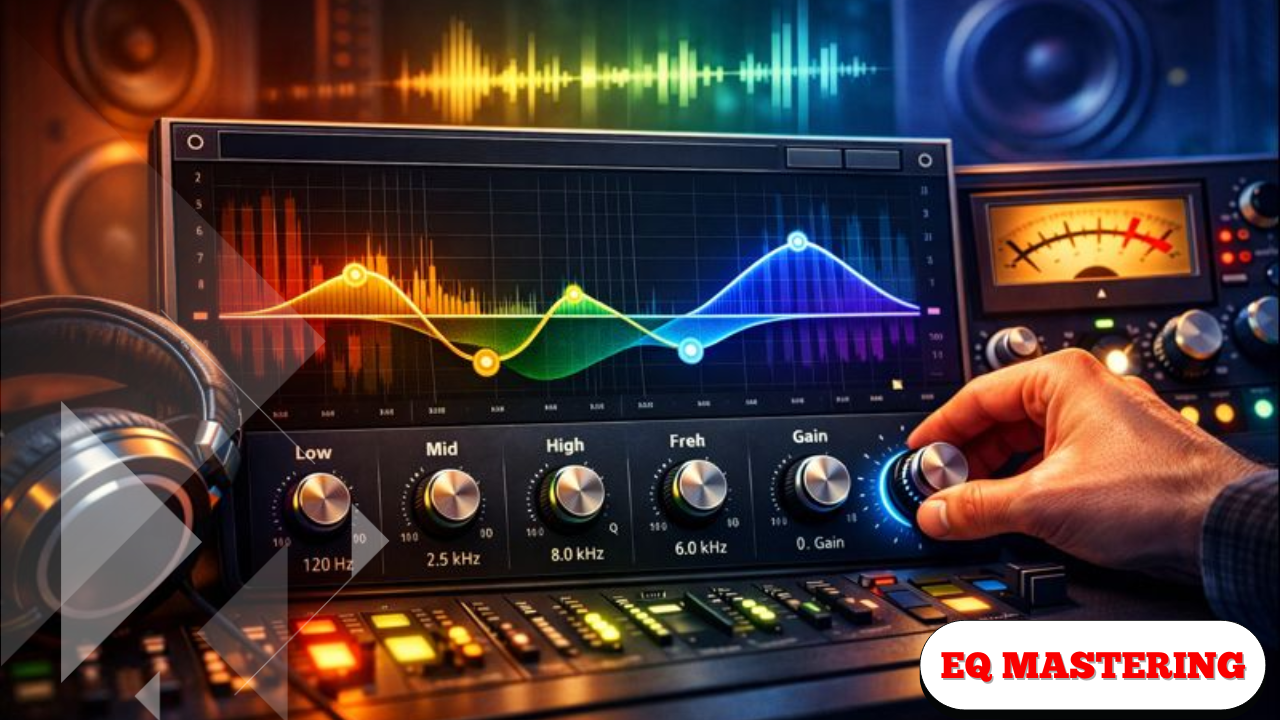
Crash Course on Equalization in Mastering
Before talking about how equalizers are used in mastering, it’s important to understand why equalizers were invented in the first place.
Equalizers were not originally creative tools. They were problem-solvers.
Nearly a century ago, EQs were developed to compensate for deficiencies in recording media and transmission systems. One of the earliest use cases was improving intelligibility over phone lines. High frequencies were often lost during transmission, so engineers applied high-frequency boosts to restore clarity—making speech understandable again.
If the transmission loses information, the equalizer restores it.
This same principle applies across all recording technologies. When something sounds too dull, an equalizer can help restore it closer to what the original sound actually was. For example, when recording an acoustic instrument, EQ can be used to bring the sound back to where it existed before the limitations of microphones, rooms, or recording chains altered it.
This idea—corrective equalization—is foundational to how mastering engineers think about EQ.
Corrective Equalization in Mastering
In mastering, equalizers are often used to undo unintended changes rather than to create new ones.
A common scenario involves receiving multiple tracks that were all mixed:
- By the same engineer
- In the same room
- Over a short period of time
In these cases, mastering can sometimes be a matter of finding the inverse EQ curve—essentially compensating for how the room, monitors, or environment influenced the mix engineer’s decisions.
Once that inverse shape is identified, it may become a consistent EQ approach applied across the entire mastering session.
The goal is not to change the mix—but to make it sound the way the mix engineer believed it already did.
Why Mastering Engineers Cut More Than They Boost
One of the most noticeable differences between mastering and mixing EQ approaches is this:
Mastering engineers tend to cut more than they boost.
Rather than adding energy, the focus is often on removing:
- Cloudy areas
- Unpleasant harmonic content
- Frequencies that contribute little fundamental tone
These problematic areas can mask clarity and definition. Removing them often reveals what’s already there—without introducing new coloration.
This approach aligns with the original corrective purpose of EQ and helps preserve the integrity of the mix.
The Psychoacoustics of Boosting vs. Cutting
An interesting insight emerges when looking at older program equalizers.
Many of these classic EQs are asymmetrical in their responses, meaning:
- The bandwidth when cutting is narrower
- The bandwidth when boosting is broader
This is not accidental.
It reflects how human hearing responds to frequency changes. Broad boosts tend to sound more natural, while narrow cuts are effective for removing specific problems without drawing attention.
It’s a psychoacoustic phenomenon—one that simply sounds better to our ears.
There Is No Universal EQ Recipe
Every piece of music requires a different approach.
There is no fixed formula for using an equalizer in mastering. Each program presents its own challenges, and responding to those challenges requires flexibility.
If an engineer finds themselves making the same EQ moves on every master, that’s often a warning sign.
It may indicate that the engineer is reacting to:
- The room acoustics
- The monitoring system
rather than to what’s actually happening in the program material.
Consistency in EQ moves often reflects environmental bias—not musical necessity.
Common Frequency Areas Addressed in Mastering
While there’s no recipe, certain patterns appear frequently in mastering work.
Clearing the Low Mid-Range
One common task is addressing low mid-range energy. This range can become congested and obscure important elements.
Carefully clearing this area can:
- Reveal bass definition
- Improve separation between bass and lead vocals
- Increase overall clarity
This is particularly relevant in:
- Pop
- Rock
- Jazz
- Vocal-centric recordings
Managing Low-Frequency Relationships
Low frequencies are notoriously difficult to judge accurately in mixing environments.
As a result, mastering engineers are often asked to refine relationships such as:
- Kick drum vs. bass
- Kick fundamental vs. kick attack
- Balance between low-end weight and definition
Even very small EQ changes in this range can dramatically alter how these elements interact.
Tiny adjustments can completely reshape low-frequency perception.
The Scale of EQ Moves in Mastering
One of the defining characteristics of mastering EQ is subtlety.
When examining typical mastering EQ settings, you’ll often see:
- Boosts and cuts of 0.5 dB
- Rarely more than 1 dB
- Occasional narrow cuts of 1–2 dB for specific problems
These moves are much smaller than what’s commonly done during mixing.
Why Small Moves Matter More Than Big Ones
There are several reasons for this restrained approach.
Working With a Complex Waveform
In mastering, the engineer is dealing with a fully balanced mix, not individual instruments.
Large EQ moves risk:
- Altering internal balances
- Changing the artist’s intent
- Emphasizing elements unintentionally
Better Sound Quality From EQ Filters
EQ filters behave better when used gently.
Broad bandwidths and small adjustments result in:
- Less distortion
- Less ringing
- More transparent results
This is why mastering often involves using multiple EQ filters simultaneously, each making only a slight contribution.
It’s not unusual to see:
- Five
- Eight
- Or even twelve EQ filters
Each one shaping the sound just a little.
Many small moves add up to a meaningful improvement—without calling attention to themselves.
The Mastering Engineer’s EQ Philosophy
Ultimately, the mastering engineer’s approach to equalization is defined by restraint, correction, and clarity.
Rather than dramatic tonal shifts, the focus is on:
- Revealing what’s already present
- Removing obstacles to intelligibility
- Preserving the artist’s intent
Equalization in mastering is less about transformation and more about precision, balance, and psychoacoustic awareness.
And that careful, deliberate mindset is what distinguishes mastering EQ from every other stage of the audio process.