
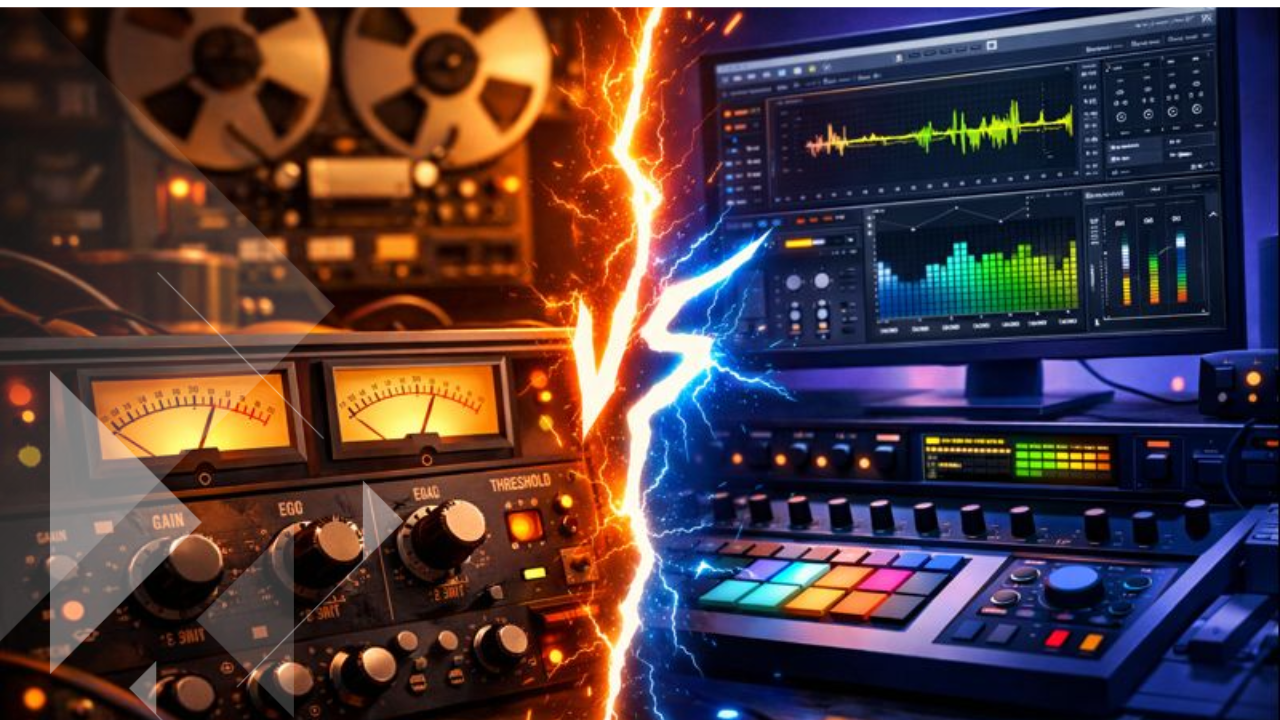
Analog vs. Digital Signal Processing at The Mastering Stage
When discussing analog versus digital signal processing, the conversation becomes especially nuanced in the realm of dynamics processing—and more specifically, compression.
While digital processing has made extraordinary strides over the years, compression remains an area where many professionals feel the analog domain still holds a meaningful advantage.
For certain tools, the debate is largely settled. Peak limiters, protection circuits, and brick-wall limiters are now overwhelmingly implemented in the digital domain. The reasons are practical and technical:
- Digital limiters are much faster
- They exhibit less overshoot
- They are generally cleaner and more precise
- They outperform analog designs in pure peak-control scenarios
In these applications, plug-ins are not merely convenient—they are often superior.
Compression, however, occupies a very different position.
Compression remains, in many ways, the final frontier where digital signal processing has not entirely matched analog performance.
Why High-End Studios Still Rely on Analog Compressors
A revealing place to observe this distinction is in the equipment roster of a high-end mastering studio. If there is any analog hardware still present, it is very likely to be a compressor.
This is not accidental.
Despite decades of advancement in DSP algorithms, modeling techniques, and processing power, analog compressors continue to appear in mastering chains where precision, subtlety, and sonic integrity are paramount.
The question naturally follows:
Why?
What Digital Compression Does Well—and Where It Falls Short
Modern digital compressors, including both algorithmic simulations and convolution-based designs, are remarkably effective at recreating the functional behavior of analog compressors.
They can accurately replicate:
- Dynamic range control
- Attack and release behavior
- Threshold and ratio interactions
- Gain reduction curves
From a strictly technical standpoint, many digital compressors perform exactly as intended.
And yet, something remains different.
They don’t quite seem to sound the same as the original compressors.
This difference is not always obvious, measurable, or easy to define—but it is consistently perceived by experienced engineers, particularly in mastering contexts.
The Role of Distortion and Noise in Analog Compression
One of the most immediate distinctions between analog and digital compression lies in what happens after the signal leaves the digital domain.
When audio passes through analog circuitry, it inevitably acquires:
- Added distortion
- Added noise
- Subtle nonlinearities
These elements are not defects in the traditional sense. In fact, they are often perceived as part of the overall presentation of the sound.
Digital signal processing, by contrast, typically aims to eliminate these characteristics entirely. DSP engineers do not generally program in noise or distortion unless it is explicitly intended as a creative effect.
The result is a difference in feel rather than function.
- Analog compression introduces small imperfections
- Digital compression strives for ideal behavior
Those imperfections, subtle as they may be, contribute to a sonic character that many listeners and engineers find musically pleasing.
The Detector Circuit: Where Compression Truly Happens
Beyond distortion and noise, there is a deeper and more fundamental difference—one that centers on the detector circuit.
The detector is the part of a compressor that decides:
- When compression occurs
- How strongly it is applied
- How it responds to signal changes over time
In other words, it is the mechanism that drives the action of the compressor.
An important idea proposed by George Massenburg sheds light on why digital compression may still fall short in this area.
The sample rate of the detector circuit may need to be significantly higher than the standard audio sample rate.
Sample Rate Limitations in Digital Detector Circuits
Standard audio sample rates—such as 44.1 kHz—are widely accepted as sufficient for capturing and reproducing audible sound. For the audio signal itself, this is generally true.
However, compression is not only about the audio passing through the system.
It is also about the audio feeding the detection circuit.
The nuances that occur at the output of a compression stage can be extremely fine-grained. These nuances may require:
- Faster temporal resolution
- Higher internal sampling
- Greater sensitivity to transient detail
At 44.1 kHz:
- The audio path may be perfectly adequate
- The detector circuit may not be resolving enough information
This does not imply that digital compression is inherently flawed—but it does suggest that current implementations may be operating within constraints that analog circuits simply do not face.
It’s speculation—but it’s an interesting thing to consider.
Why Analog Filtering Changes the Sound—Even Without Compression
Another often-overlooked reason analog compressors remain in use has nothing to do with compression itself.
In many mastering environments, engineers will pass audio through an analog compressor without applying any gain reduction at all.
Why would they do this?
Because of the filtering effect introduced by the analog signal path.
When audio runs through analog circuitry, subtle changes occur:
- Frequency-dependent phase shifts
- Minor tonal reshaping
- Cumulative harmonic effects
These changes are not always dramatic, but they can be desirable.
Using Analog Gear for Sound, Not Processing
It is not uncommon to see an expensive, high-end analog compressor in a mastering chain that is:
- Not compressing
- Not equalizing
- Not actively altering dynamics
And yet, it remains in the signal path.
The reason is simple:
There is something about the sound imparted by that analog gear that improves the program material.
In this context, the compressor functions less as a processor and more as a sonic filter—one that subtly shapes the sound in ways that are difficult to replicate digitally.
The Ongoing Gap Between Analog and Digital Compression
Digital compression has become extraordinarily capable, efficient, and flexible. For many applications, it is more than sufficient—and often preferable.
Yet in critical listening environments, especially mastering, analog compression continues to occupy a unique space.
Not because it is more accurate.
Not because it is more controllable.
But because of:
- The nonlinearities of analog circuitry
- The behavior of analog detector paths
- The filtering effects of real-world components
- The cumulative sonic imprint of hardware signal paths
These factors combine to create results that, at least for now, remain difficult to fully reproduce in the digital domain.