
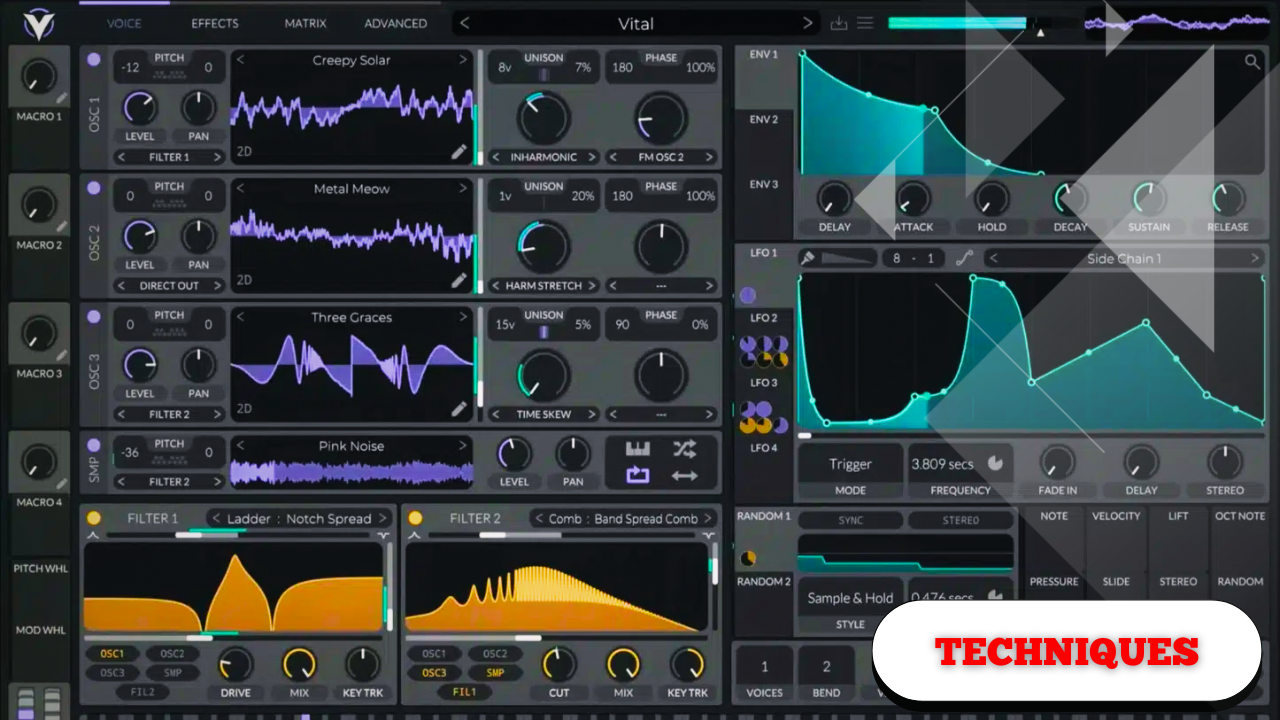
Advanced Sound Design Techniques (Synthesis, Modulation, and Effects)
Sound design builds in layers. Once the fundamentals are in place, more advanced techniques begin to shape character, movement, and depth in ways that simple presets cannot. The focus here is not theory-heavy explanations, but how these techniques actually sound, how they interact, and how they can be applied in practical musical contexts.
This article explores several advanced sound design concepts, including FM synthesis, envelopes, filters, LFO behavior, cross-synth translation, and effects processing, framed through real-world sound design workflows and decision-making.
FM Synthesis: Adding Harmonic Complexity Through Modulation
In frequency modulation (FM) synthesis, one oscillator generates the audible signal, while another oscillator modifies it.
- The carrier is the oscillator you hear.
- The modulator shapes the carrier by altering its frequency.
- The modulator itself does not need to be audible.
“If I play it on its own there’s actually no sound going to be generated for this — this is going to be our modulator.”
The result is not subtle. FM synthesis introduces large amounts of harmonic content, dramatically changing the timbre of a sound.
Harmonics, Pitch, and Waveform Interaction
As modulation depth increases, additional harmonics appear across the frequency spectrum. These harmonics shift depending on:
- The waveform used for modulation
- The pitch of the modulating oscillator
- The amount of modulation applied
Using visual tools like frequency analyzers makes it clear how FM synthesis fills out the harmonic spectrum.
“You can see that a whole load of harmonics are being added to that signal.”
The process is often exploratory. The modulation amount is adjusted until the sound feels right rather than mathematically precise.
Designing FM Bass Sounds
From Simple Sine to Harmonic-Rich Bass
A clean sine-based bass can be transformed using FM techniques:
- Start with a plucky sine bass
- Introduce FM modulation using a second oscillator
- Dial in modulation carefully
- Reinforce low frequencies with a dedicated sub layer
The result is a bass sound with far more character and presence, though FM often reduces low-end energy on its own.
“We’ve lost a lot of the low-end, so I’m just going to add another sub.”
Layering for Balance
Rather than forcing one patch to handle everything:
- Use layered bass sounds
- Combine a harmonically rich FM bass with a clean low-end
- Allow each layer to serve a specific purpose
This approach maintains clarity while preserving complexity.
FM Synthesis in Classic Instruments
FM synthesis is not limited to modern digital tools. Several iconic synthesizers rely heavily on it.
Notable FM-Based Instruments
- Synclavier
- Known for bell-like tones, marimbas, pads, and sound effects
- Yamaha DX7
- Famous for lush pads and expressive harmonic textures
“You’ve got all these marimba and bell-like sounds… incredible pads.”
FM synthesis rewards long-term exploration. Over time, the relationship between modulators, carriers, and effects becomes intuitive.
Envelopes: Shaping Punch, Pluck, and Dynamics
Volume Envelopes vs. Filter Envelopes
A sound may look correct on paper but still feel flat. Volume envelopes alone often fail to create impact.
- Fast attack and decay shape loudness
- Filter envelopes shape perception of punch
“Even though my amplitude envelope seems perfect, I’m not getting any thump.”
Using Envelopes to Control Filter Cutoff
Instead of using an LFO, applying an envelope directly to the filter cutoff allows the sound to:
- Open quickly at the transient
- Sweep through high frequencies
- Close rapidly
This motion creates the plucky, percussive impact often missing from static sounds.
“That’s what really gives us that pluck or thump.”
Filter Characteristics Matter
Changing filter types and parameters dramatically affects tone:
- Resonance emphasizes frequencies near the cutoff
- Drive adds saturation and weight
- Different filter models impart unique character
“Filters are often praised or loved because of their character.”
Filters are not neutral tools — they define identity.
LFOs: Movement, Modulation, and Control Behavior
Beyond Simple Filter Modulation
Low Frequency Oscillators can control nearly any parameter:
- Volume
- Filter cutoff
- Pan
- Effects parameters
Changing the shape of an LFO radically changes behavior:
- Smooth curves create gentle motion
- Square waves create rhythmic gating and stutters
“You can create sort of stuttering effects like this from within a synth.”
Trigger Modes and Timing Considerations
LFOs behave differently depending on how they are triggered:
- Free-running: synchronized internally
- Key-triggered: resets per note
This matters when playing chords or layered notes.
“If you don’t hit them at the perfect time, it might stutter that LFO and really mess up your sound.”
Understanding trigger modes avoids unwanted rhythmic artifacts.
Subtle Modulation for Width and Motion
Small LFO movements often sound more professional than extreme ones.
For example:
- Applying an LFO to pan
- Reducing modulation range
- Slowing the rate
“It’s added a huge amount of movement to the sound.”
Subtlety creates depth without distraction.
Translating Knowledge Between Synthesizers
Breaking Down Unfamiliar Interfaces
Different synthesizers may look intimidating, but the fundamentals remain consistent:
- Oscillators generate sound
- Envelopes shape time
- Filters sculpt tone
- Effects add space and texture
The process begins by simplifying:
- Turn off reverb, delay, and modulation effects
- Identify oscillators and mixer levels
- Listen to each component in isolation
“Don’t panic — just take each control one by one.”
Understanding Detuning and Width
Fine-tuning oscillators slightly apart creates width and richness, similar to unison detuning in modern synths.
“That changes the sound dramatically.”
The same principles apply, even when controls are labeled differently.
Learning Through Reverse Engineering
One effective way to improve sound design skills is imitation.
Practical Reverse Engineering Workflow
- Load a complex preset
- Initialize a blank patch
- Match parameters step by step
- Listen after every adjustment
This method reveals what each control contributes.
“At each stage I’d be listening out to see what each dial does.”
Although time-consuming, the process builds deep understanding.
Effects Processing and Signal Flow
How Effects Transform Sound
Even simple sounds change dramatically with effects:
- Distortion adds texture and edge
- Reverb adds depth
- Delay introduces rhythm and space
Certain distortion types, such as downsampling or bit reduction, introduce character beyond traditional saturation.
“I didn’t know distortion had these beautiful options.”
Effect Order Matters
The sequence of effects alters the result:
- Delay before reverb sounds different than reverb before delay
- EQ placement affects clarity and balance
- Low-cut filters prevent unwanted rumble
“If you push the reverb on top of the delay, it’s going to sound subtly different.”
Sound design does not stop inside the synth — the mixer is part of the instrument.
Exploration, Community, and Shared Knowledge
Sound design evolves through curiosity and experimentation. Understanding names, techniques, and tools often comes from discussion rather than manuals.
- Ask questions
- Share sounds
- Learn terminology
- Participate in creative communities
“Don’t be afraid to ask if you don’t know the name of a sound.”
The process takes time, but consistent exploration builds confidence and control.