
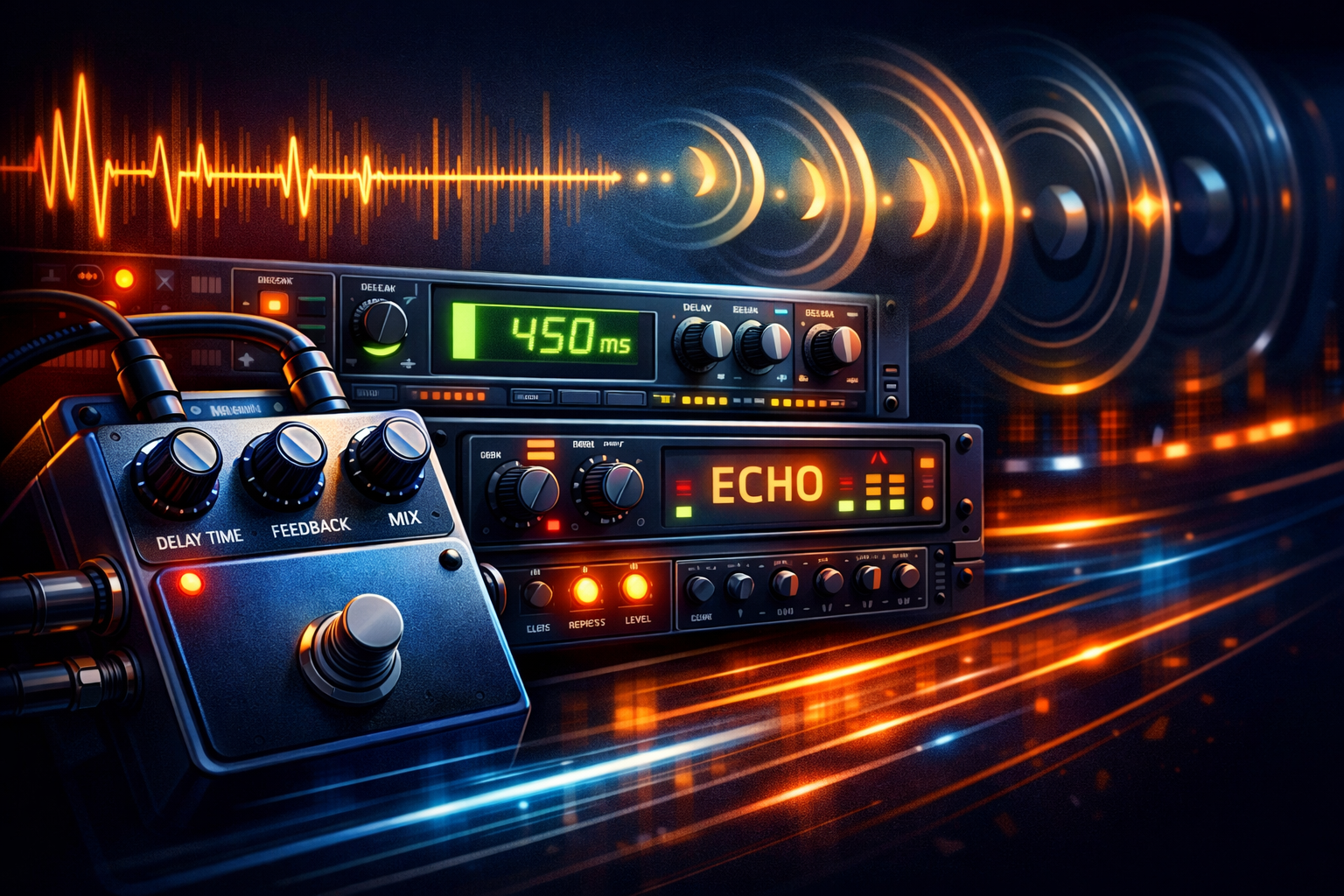
Conventional Echo and Delay Effects: Techniques, Timing, and Creative Applications
Conventional echo and delay effects operate at delay times of 70 milliseconds and greater.
At these longer delay times, the ear perceives discrete repeats rather than a fused or comb-filtered sound. These repeating effects form the foundation of many spatial and rhythmic treatments used in music production.
Historically, repeating delay effects could be created using a tape recorder. In such systems, the maximum possible delay time was limited by the slowest speed at which the tape recorder could operate. Once that mechanical limit was reached, no further extension of delay time was possible.
Digital systems removed this restriction entirely.
No such limitations exist for digital delay lines.
Modern digital delay lines are capable of long delay times and multiple simultaneous delay paths, opening up a wide range of creative and technical possibilities that were impractical or impossible with tape-based systems.
The Role of Long Delay Times in Audio Processing
There are no strict rules governing how time-domain effects with longer delay times must be used. However, certain approaches have become common because they reliably deliver musical and spatial benefits.
Delay is frequently employed to:
- Add spatial dimension
- Introduce a sense of movement
- Enhance fluidity in a performance
- Support essential elements such as:
- Lead vocals
- Solo instruments
Rather than drawing attention to itself, delay in these contexts is often designed to remain supportive, subtle, and musically integrated.
Typical Stereo Delay Settings for Spatial Enhancement
A widely used configuration involves a stereo delay algorithm with slightly offset delay times between the left and right channels. This asymmetry creates width and movement without cluttering the mix.
Typical settings include:
- Stereo delay algorithm
- Left channel delay time: 445 milliseconds
- Right channel delay time: 455 milliseconds
- Feedback:
- Set low enough that only two or three repeats are heard
- Modulation:
- None
- Low-cut filter:
- Removes frequencies below 500 Hz
- High-cut decay:
- Significantly dulls the sound of repeats
- Ensures the delayed signal does not clash with the source
- Level balance:
- The effect is set significantly quieter than the source signal
This approach allows the delay to provide depth and movement while remaining unobtrusive.
The goal is enhancement, not competition with the original sound.
Harmonic and Pitch-Controlled Delay Repeats
Some modern digital delay devices and plugins allow the pitch of repeats to be precisely controlled. This capability extends delay beyond simple repetition and into a more harmonic and musical role.
By determining the pitch of each repeat:
- Delays can reinforce musical key centers
- Repeats can form complex harmonic structures
- Effects can remain musically consonant rather than chaotic
This precision makes it possible to design musically harmonic delay effects that interact directly with the tonal content of the performance.
Rhythmically Synchronized Delay Effects
In many musical contexts, it is desirable for delay effects to be rhythmically synchronized to the tempo of a piece. Rather than setting delay times by ear alone, a simple calculation can be used to align delays exactly with the musical pulse.
Delay Time Calculation Formula
To calculate a beat-based delay time in milliseconds:
- Take 60,000
- Divide it by the tempo in beats per minute (BPM)
This produces a quarter-note (one beat) delay time in milliseconds.
Example Calculation
- Tempo: 120 BPM
- Calculation:
- 60,000 ÷ 120 = 500 milliseconds
- Result:
- A half-second delay corresponding to one beat
Once the quarter-note value is known, other rhythmic subdivisions can be derived easily, allowing delays to lock tightly to the groove of the music.
Ping-Pong Delay and Stereo Movement
Ping-pong delay is a stereo effect in which repeats alternate, or “bounce,” between two loudspeakers. This creates a pronounced sense of width and motion across the stereo field.
This effect can be achieved using:
- Two separate delay lines, or
- A single delay line with precise control over the panning of repeats
Typical Ping-Pong Delay Settings
Common settings include:
- Tempo-synchronized delay time
- High amounts of feedback
- No modulation
The rhythmic interaction between left and right channels allows the delay to become an active part of the arrangement rather than a static background effect.
The repeats themselves become a moving stereo event.
Multi-Tap Delay Lines and Complex Rhythmic Patterns
A multi-tap delay line allows multiple individual delay lines to be combined within a single effect. Each delay line—or “tap”—can be configured independently.
Key characteristics include:
- Each delay line can have a different delay time
- Each tap can derive its source from:
- The original source signal, or
- One of the other delay lines
- Delay times can be subdivided into complex relationships
This structure enables the creation of rhythmic patterns that would be impossible using traditional tape delay techniques.
By carefully designing the relationships between taps:
- Intricate rhythmic textures can emerge
- Patterns can interlock and evolve over time
- Delays can function almost like rhythmic instruments
Expanding Creative Possibilities with Digital Delay
Digital delay systems remove the physical constraints of tape and introduce:
- Long delay times
- Multiple simultaneous delay paths
- Precise control over timing, pitch, filtering, and panning
These capabilities allow delay effects to move far beyond simple echoes, becoming tools for spatial design, rhythmic articulation, and harmonic reinforcement within a mix.