
Crash Course on Bass Sound Design: 808s, Subs and More
Sound design is one of those areas where small technical decisions have a huge musical impact. When it comes to bass, those decisions define weight, movement, and energy in a track. This guide breaks down four essential bass tones that form the backbone of countless productions:
- The 808 bass
- A punch or pluck bass
- A saw or growl bass
- A simple sub bass
Each sound is introduced, analyzed, and constructed step by step, focusing on fundamental synthesis concepts that translate to any synthesizer. While a third-party synth is used here for clarity, the techniques themselves are universal.
The Four Core Bass Sounds at a Glance
Before diving into sound creation, it’s useful to understand what roles these basses typically play:
- 808 Bass – Deep, sustained, punch-capable low-end with tonal control
- Punch / Pluck Bass – Short, percussive bass often used in dance and house music
- Saw / Growl Bass – Aggressive, wide bass that responds well to sidechaining
- Sub Bass – Clean, fundamental low-frequency support
Each one occupies a different space in the mix and responds differently to rhythm, envelopes, and processing.
1. The 808 Bass: From Drum Machine to Modern Low-End Weapon
Understanding the Modern 808
The original 808 comes from the TR-808 drum machine, but the modern 808 bass is often far removed from that source. Most producers:
- Use samples from packs
- Drag them into a sampler
- Adjust pitch and patterns in a piano roll
That approach works—but synthesizing an 808 from scratch provides far more control over punch, tone, and character.
Synthesizing an 808 allows you to shape punch, grit, and sustain instead of relying on a fixed sample.
Building the Core Tone
Start with:
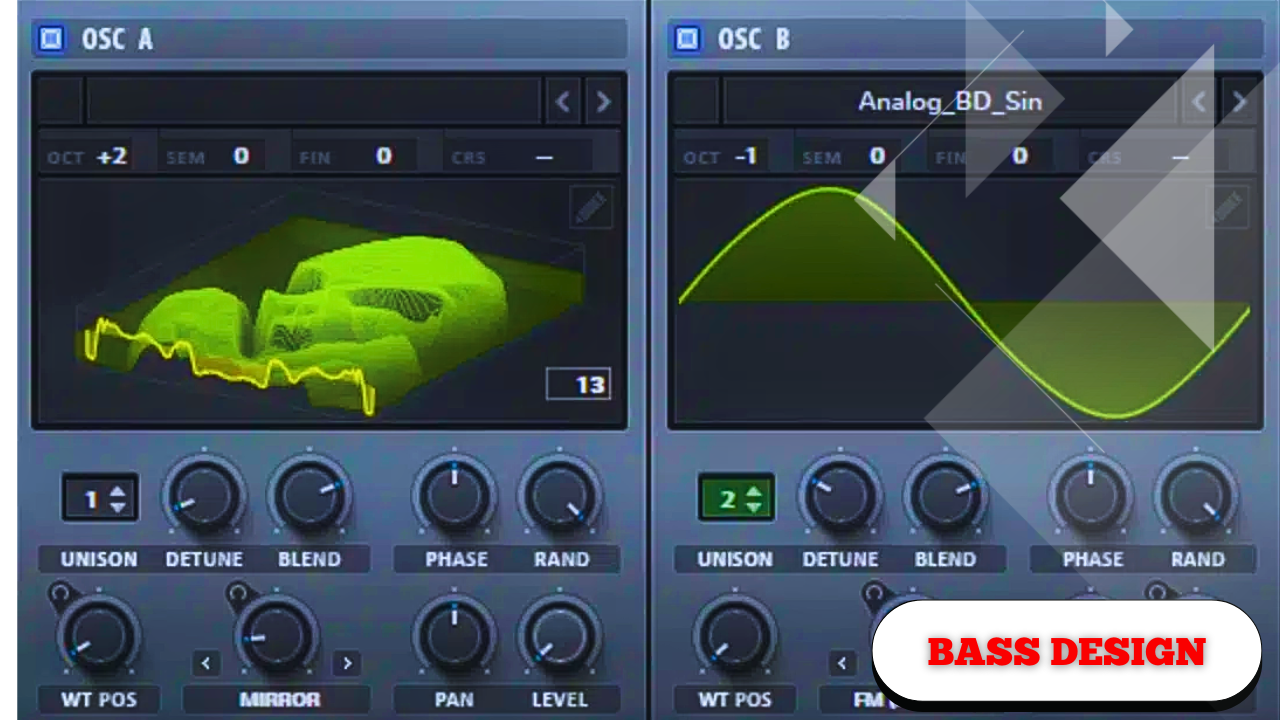
- One oscillator
- Sine wave
- Lower octave playback
This creates a clean, fundamental sub tone.
Next, shape the amplitude envelope:
- Attack: 0 (later adjusted slightly to remove clicks)
- Hold: ~300–400 ms
- Decay: ~1.5 seconds
- Sustain: 0%
This produces:
- A sharp onset
- A brief hold
- A smooth decay
If a click appears at the start, slightly increase the attack until it disappears.
Adding Character with Waveform Warping
To avoid a completely sterile tone:
- Enable Bend ± (warp mode)
- Apply a subtle amount
This introduces harmonic character without overwhelming the sub.
The Crucial Step: Pitch Envelope Punch
For a truly punchy 808, a short pitch envelope is essential.
Create a second envelope:
- Very fast attack
- Extremely short decay
- No sustain
Route it to:
- Global Master Tune
This creates a brief pitch drop, producing a kick-like transient at the start.
This quick pitch movement is what gives an 808 its impact.
Distortion, EQ, and Mix Interaction
Apply light processing:
- Tube distortion with restrained mix
- EQ boost around ~100 Hz for added weight
When combined with a kick:
- If both are too punchy, increase the 808’s attack time (around 80–100 ms)
- Let the kick provide the transient
- Let the 808 fill the space afterward
This often removes the need for sidechaining entirely.
2. Punch or Pluck Bass: Tight, Rhythmic, and Dancefloor-Ready
What Defines a Pluck Bass?
Often associated with:
- House
- Deep house
- Four-on-the-floor rhythms
This bass is defined by:
- Short decay
- Strong transient
- Controlled sustain
Initial Setup
Start from a clean preset:
- Choose a square wave
- Set voicing to mono
- Enable a low-pass 24 dB filter
The raw oscillator will sound buzzy and aggressive—this is expected.
Envelope Shaping for Pluck Behavior
Amplitude envelope:
- Small attack
- No hold
- Sustain pulled down
- Slight release
This shapes the volume, but not the punch yet.
Filter Modulation: Where the Pluck Comes From
Use the same envelope to modulate:
- Filter cutoff
Adjust the amount until:
- The sound snaps open
- Then quickly closes
Add slight filter drive for subtle saturation.
The pluck comes from filter movement, not just volume shaping.
Adding Width with a Second Oscillator
To modernize the sound:
- Add a second oscillator
- Choose a brighter waveform
- Increase unison voices (5–7)
- Slight detune
- Route it through the same filter
This creates:
- A solid mono low-end
- With wide, airy upper harmonics
Spatial Effects (Used Carefully)
Optional enhancements:
- Light delay
- Subtle reverb
Key adjustments:
- High-pass the reverb
- Reduce low-end buildup
- Keep frequencies below ~100–150 Hz mono
Stereo width belongs in the highs, not the sub.
3. Saw or Growl Bass: Aggressive, Wide, and Sidechained
Core Character
This bass is defined by:
- Sawtooth waves
- Heavy unison
- Sidechained movement
The default saw waveform already provides the foundation.
Oscillator and Envelope Setup
- Two oscillators
- Multiple unison voices (7–8)
- Slight detune
- Mono voicing
- Very short release
Clicks and pops are acceptable here—the sound is intentionally abrasive.
Creating the Sidechain Movement
Instead of external compression:
- Use an LFO
- Assign it to oscillator volume
Choose a sidechain-shaped LFO curve and adjust:
- Start position
- Length
- Depth
Apply the same LFO to both oscillators.
The bass now breathes around the kick without external processing.
Filter Control and Macros
- Route both oscillators through the filter
- Assign cutoff to a macro
- Control tonal intensity in real time
Optional:
- Assign reverb and delay to macros
- Blend spatial effects dynamically
Sound Quality and Low-End Reinforcement
To keep the sound clean:
- Set oscillator quality to highest
If the bass feels thin:
- Boost low-end with EQ (around 120–150 Hz)
The growl lives in the highs—but the bass still needs weight.
4. Simple Sub Bass: Clean, Controlled, and Essential
Choosing the Right Waveform
The sub bass is the simplest:
- Sine wave
- Single voice
- Low register
Alternative sine-based waves also work well.
Eliminating Clicks with Envelope Control
Critical envelope settings:
- Attack: ~5 ms
- Release: Slight, not instant
Without this:
- Clicks appear at note start and end
With it:
- Smooth, musical transitions
Mono Behavior for Clean Performance
Enable mono mode:
- Prevent overlapping notes
- Ensure smooth pitch transitions
- Avoid low-end buildup
Sub bass works best when it behaves predictably.
A Shared Principle Across All Bass Sounds
Across all four bass types, a few concepts repeat:
- Envelope shaping defines character
- Pitch and filter modulation add punch
- Mono control protects the low-end
- Subtle processing goes further than heavy effects
These bass sounds may differ in texture and aggression, but they all rely on the same fundamental synthesis principles—applied with intention and restraint.