
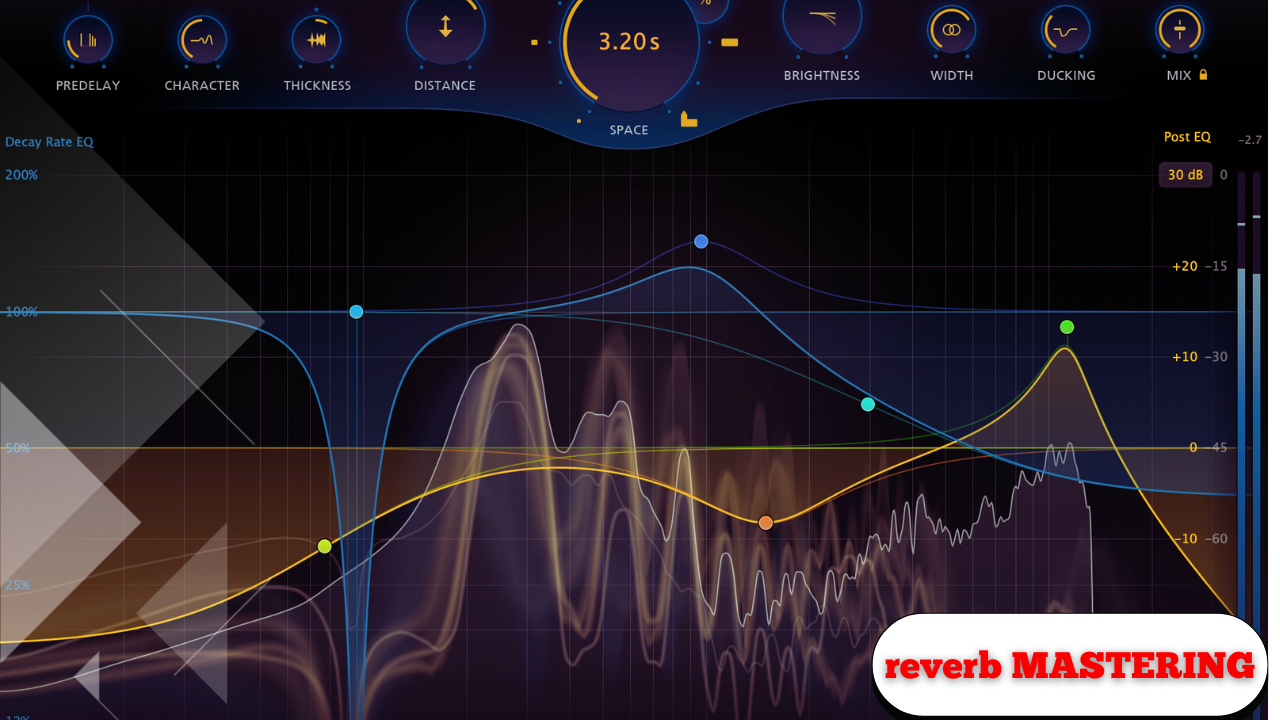
Crash Course on Reverb in Mastering
Reverb is often associated with tracking and mixing, but it also plays a quiet yet meaningful role in mastering. In some cases, its use is obvious. In others, it’s far less expected—and sometimes surprising. When applied carefully, reverb can solve problems that no amount of equalization or compression can address on its own.
In mastering, reverb is never about effect. It is about correction, continuity, and depth. It is used sparingly, intentionally, and often invisibly. What follows is a detailed exploration of how reverb can be applied during mastering, preserving the integrity of the material while subtly enhancing the listening experience.
Reverb as a Tool for Extending the Tail of a Song
One of the most practical and common uses of reverb in mastering is lengthening the tail of a piece of music—especially when the ending has been cut too short.
The Problem of Overly Tight Edits
A frequent issue arises when an engineer, artist, or producer decides to trim the beginning or ending of a song too closely before it reaches mastering. This is often done with good intentions:
- To save time
- To reduce studio costs
- To “pre-finish” the track
However, this approach often creates unintended problems.
“Invariably what happens is that they cut the beginning too close or they cut off something at the very end.”
The result may be:
- A final note that feels rushed
- A decay that doesn’t resolve naturally
- A musical moment that feels interrupted
In some cases, the issue isn’t just musical—it’s technical.
Managing Noise at the End of a Mix
Sometimes, a mix contains unwanted noise at the end:
- Room noise
- Equipment hum
- Background artifacts
To prevent these sounds from distracting the listener, a fade is often applied. But pulling a fade too early can rob the music of its natural decay.
This is where reverb becomes useful.
Applying Reverb to Extend the Decay
In mastering, reverb can be applied only to the very end of the song:
- The reverb level rises gradually
- It follows the decay of the final note
- It creates the illusion of a longer natural tail
The goal is not to add ambience for its own sake, but to restore what feels musically necessary.
Key considerations include:
- Applying reverb only at the tail
- Keeping the transition smooth and natural
- Matching the character of the existing sound
When done correctly, the listener never perceives the reverb itself—only a satisfying sense of completion.
Using Reverb to Match Recordings from Different Acoustic Spaces
Another important application of reverb in mastering involves sonic consistency across multiple recordings.
The Challenge of Mixed Acoustic Environments
Albums are not always recorded in a single space. In many cases, especially with classical and orchestral material, recordings may come from:
- Different studios
- Different concert halls
- Different cities or countries
Each space carries its own acoustic fingerprint.
“One might be dry and one might be ambient.”
When these recordings are placed back-to-back on an album, the differences can be distracting.
Differences in Engineering Aesthetics
Beyond the room itself, engineering choices also vary:
- How much ambience is allowed into the microphones
- How much natural reverb is preserved
- How closely the sound is captured
Each engineering team brings its own aesthetic, often influenced by:
- The size of the room
- The style of the music
- Personal preference
These choices may work perfectly on their own—but not always together.
Creating a Shared Sonic Universe
In mastering, reverb can be used to gently unify recordings that originate from different spaces.
Rather than removing ambience, the approach is often to:
- Add a subtle amount of reverb to the drier recordings
- Bring them closer to the more ambient ones
- Create continuity from track to track
“I might apply some reverb to one of the recordings to bring them into a similar sonic universe.”
This is particularly important when:
- The album features a single composer
- The works are recorded in multiple locations
- The listener is expected to experience the album as a cohesive whole
The goal is not uniformity, but compatibility—so that transitions feel intentional rather than jarring.
Adding Depth When EQ and Compression Are No Longer Helping
There are moments in mastering when all the usual tools have been exhausted.
When Traditional Tools Fall Short
After careful adjustments with:
- Equalization
- Compression
- Dynamics processing
There may still be something missing.
“I just want a very tiny sense of warmth… a widening and deepening of the soundstage.”
At this stage:
- More EQ makes things worse
- More compression reduces clarity
- The sound becomes constrained rather than enhanced
This is where reverb can quietly step in.
Using Reverb to Create Depth and Space
A very small amount of reverb can introduce:
- A sense of depth
- A subtle spatial dimension
- A feeling of openness
The effect is not obvious. It is felt rather than heard.
A typical approach may include:
- A very short decay
- Minimal brightness
- Extremely low level
A Practical Reverb Recipe
A restrained reverb setting often works best:
- High-frequency roll-off: around 2.5 kHz to 3 kHz
- Decay time: approximately two-thirds of a second
- Mix level: just a touch
This combination avoids drawing attention while still providing dimension.
“Sometimes that gives me just that sense of depth that I’m after in a very natural way.”
Unlike EQ or compression, reverb can affect how sound exists in space, not just how it behaves dynamically or tonally.
Knowing When Reverb Is the Wrong Choice
While reverb can be useful, it is not universally appropriate.
The Risk of Softening the Program
Reverb naturally introduces:
- Reflections
- Time-based smearing
- A sense of distance
For some genres, this can be problematic.
If applied carelessly, reverb can:
- Reduce immediacy
- Dull impact
- Soften transient energy
Genres That Demand Edge and Urgency
Certain styles rely heavily on directness:
- Heavy metal
- Punk rock
- Aggressive, fast-paced music
In these cases, reverb can work against the core intent of the material.
“Reverb will soften the general sense of the program.”
That doesn’t mean it can never be used—but it demands extreme caution.
A Tool to Be Used Sparingly
In mastering, reverb is not a default process. It is:
- Situational
- Purpose-driven
- Carefully evaluated
When it works, it solves problems elegantly. When misused, it can undermine the entire presentation.
“It can come in handy—but only when you know exactly why you’re using it.”