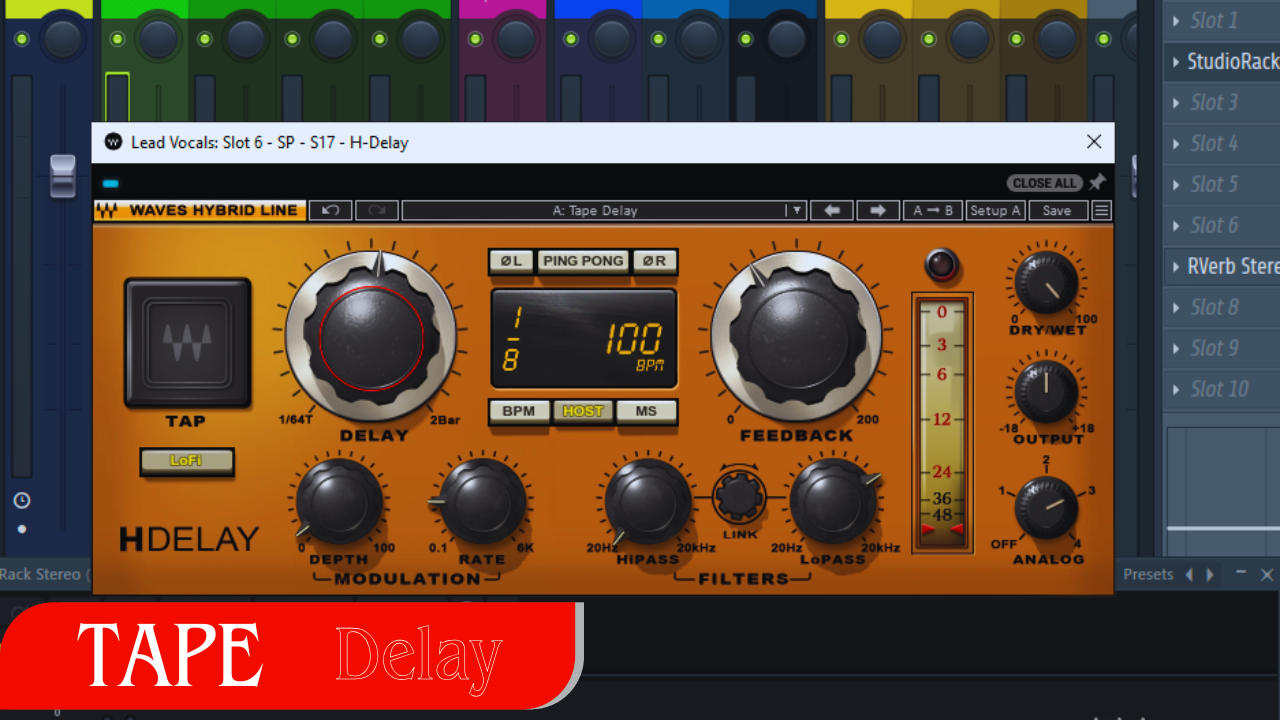
Time domain effects were first made possible when sound engineers discovered they could exploit the physical gap between the record and repro heads of a tape recorder.
This simple mechanical spacing allowed audio to be delayed naturally, and by adjusting the tape machine’s speed control, engineers could modulate both delay time and pitch.
That discovery laid the groundwork for everything that followed.
Even today, the five primary parameters of time domain effects still derive their names and behaviors directly from these early tape-based processes. Because of this, understanding how tape delay works provides an essential foundation for configuring solid-state and digital delay lines to create modern time-domain effects.
The Five Core Parameters of Time Domain Effects
The language of time domain processing comes directly from tape delay workflows. The primary parameters remain consistent across analog, solid-state, and digital systems:
Delay Time
Feedback
Modulation Speed
Modulation Width
High-Frequency Decay
These parameters describe what happens to the copied signal over time and how it interacts with the original source. While modern tools may present them in streamlined interfaces, their behavior is still rooted in the physical realities of tape.
Understanding tape delay signal routing is the key to understanding how all time domain effects behave.
Creating a Delayed Signal: Early Tape Delay Signal Routing
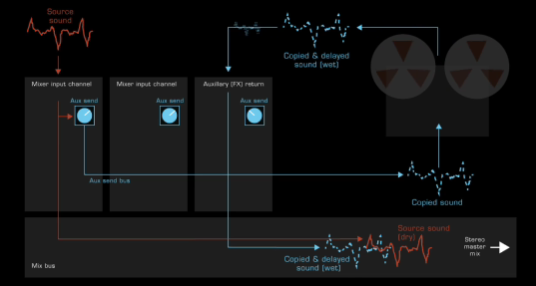
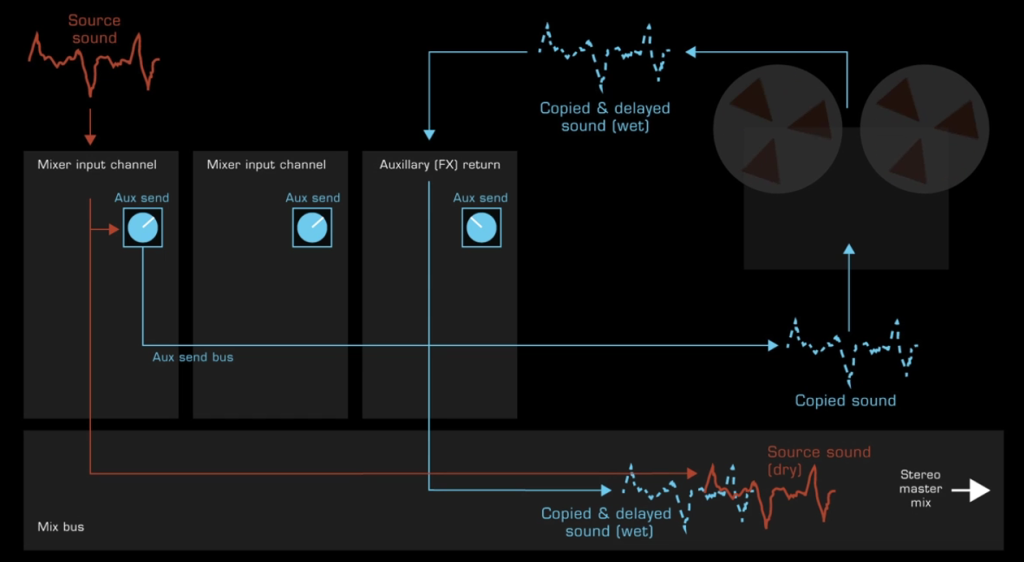
At its core, delay is created by making a copy of a source signal and playing it back later in time. There are many ways to create this copy today, but the original method relied on auxiliary send buses and dedicated tape machines.
The process begins at the mixer.
Using an Auxiliary Send Bus to Generate Delay
The source signal travels down a mixer input channel strip, just as it would during normal operation. From there:
An auxiliary send bus creates a first-generation copy of the source signal
This copy is sent to a mono or two-track tape recorder
The tape recorder is used exclusively for creating the delay effect
Once recorded, the tape machine introduces a delay determined by the distance between its heads and the tape speed.
Returning the Delayed Signal to the Mixer
After the tape recorder delays the signal:
The delayed copy is returned to the mixer
It is input on a separate dedicated mixer input or an auxiliary return channel
The delayed signal and original source signal are now available simultaneously
This setup allows engineers to combine and balance the two signals using their individual channel faders.
The original signal remains intact while the delayed copy is treated as a separate sound source.
Balancing Dry and Wet Signals
In conventional sound engineering terminology:
The source signal is referred to as dry
The copied and delayed signal is referred to as “wet.”
The dry signal is also sometimes called the direct sound
By adjusting fader levels, engineers can control:
The prominence of the delay
The clarity of the original signal
The perceived depth and space in the mix
Crucially, any channel on the mixer can access the delay effect via its own auxiliary send bus, making this approach both flexible and efficient.
Insert Effects and Modern Plugin Workflows
With the introduction of plugins, the routing process changed—but the underlying principles remained the same.
Modern delay plugins allow the dry and wet signals to be balanced within the plugin itself, making it possible to:
Insert the delay directly into a channel’s signal path
Control delay time, feedback, modulation, and tonal shaping internally
However, this configuration comes with an important limitation:
When a delay is inserted directly on a channel, it cannot be shared with other channels.
This tradeoff mirrors the difference between send-based and insert-based processing that originated with tape delay workflows.
Extremely Short Delay Times and Their Limitations
Not all time domain effects operate within the same time ranges.
Phasing, flanging, and chorus use the shortest delay times of all time domain effects, typically:
Between 1 and 30 milliseconds
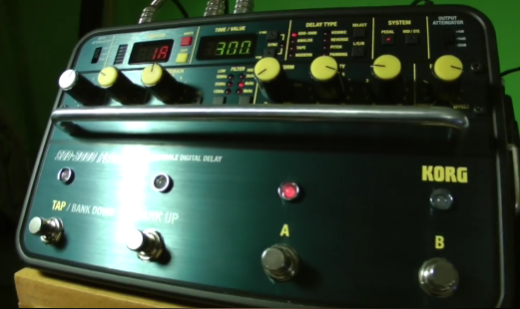
Analog solid-state and digital delay lines are capable of producing these extremely short delays. However, most tape recorders are not.
This limitation forced engineers to develop alternative techniques.
Producing Short Delays with Tape Recorders
Instead of using a conventional send-and-return configuration, engineers adopted a different method:
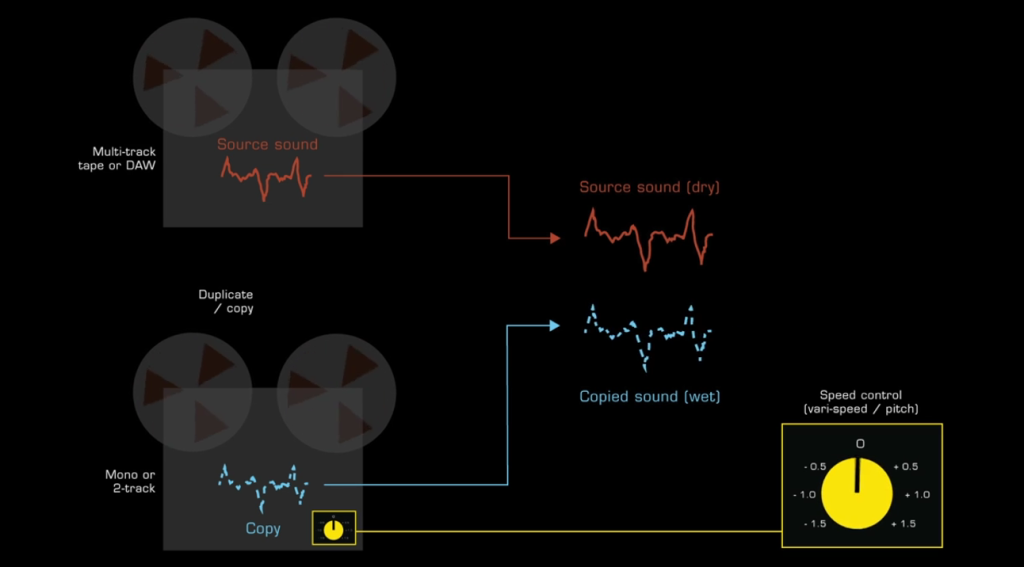
A complete duplicate of the source performance is recorded to tape
The tape is then rewound
Playback is synchronized with the original source signal
This approach eliminates the need for extremely short head spacing while still producing a controllable delay.
Using Tape Speed to Control Delay and Modulation
Once the duplicated performance is playing back in sync:
The vary-speed control of the tape recorder is used to set the delay time
That same control is used to modulate the delay
Because tape speed directly affects both time and pitch, modulation naturally introduces pitch variation—one of the defining characteristics of tape-based effects.
Delay time and pitch modulation are inseparable in tape systems.
Physical Tape Manipulation as a Modulation Technique
An alternative modulation method involved direct physical interaction with the tape machine itself.
Engineers would:
Place a hand on the flange or rim of the tape reel
Slightly slow the reel by applying pressure
Create subtle and continuous changes in delay time
This technique became closely associated with the sound of flanging and contributed to its distinctive movement and texture.
Dry and Wet Signal Interaction
Across all tape delay techniques, the relationship between dry and wet signals remains central.
The dry signal provides clarity and definition
The wet signal introduces space, movement, and repetition
The interaction between the two defines the perceived effect
Whether combined subtly or aggressively, these signals are usually blended together to achieve the desired sonic result.
Tape Delay as the Foundation of Time Domain Processing
Every major concept in time domain effects—delay time, modulation, feedback, and tonal decay—can be traced directly back to tape delay practices.
Understanding these original workflows provides clarity when working with:
Solid-state delay lines
Digital delay processors
Software-based plugins
The tools may have changed, but the principles remain the same.